DacorRepair Miami

Miami-Dade · Broward · Palm Beach

Dacor repair in Miami, on equipment that was chosen, and fitted in.

Two questions come before the problem itself on this make: how the appliance is held, and which side of 2016 it was built. The first decides how long it takes to reach — almost everything here is panel-ready or fitted into joinery. The second decides the code table, the control board and the part number, because this badge changed hands and the two generations share nothing.

  • 10 appliance types we cover on this make
  • 45 jobs with a published figure
  • 68 documented codes, across two eras
  • from $95 diagnostic, credited to the repair

Start from the appliance

What we repair

10 appliance types, and each card says what the work on that one really is here. Every one is written from what this make actually builds — an ultra-premium built-in kitchen with no laundry in it at all, one freezer format, and a coffee system that was discontinued without a successor.

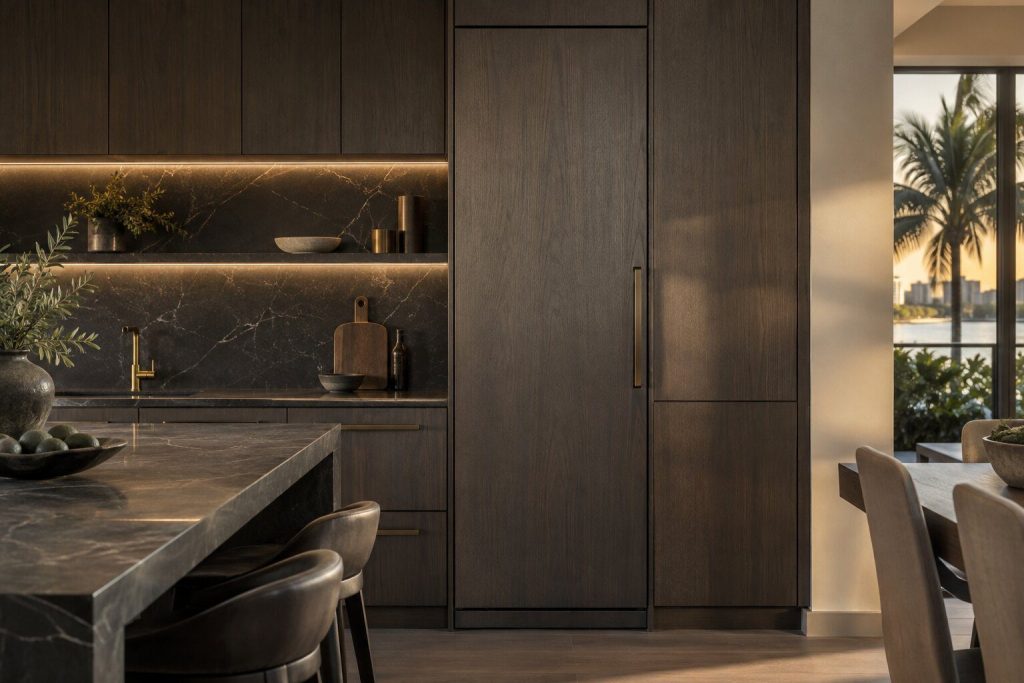
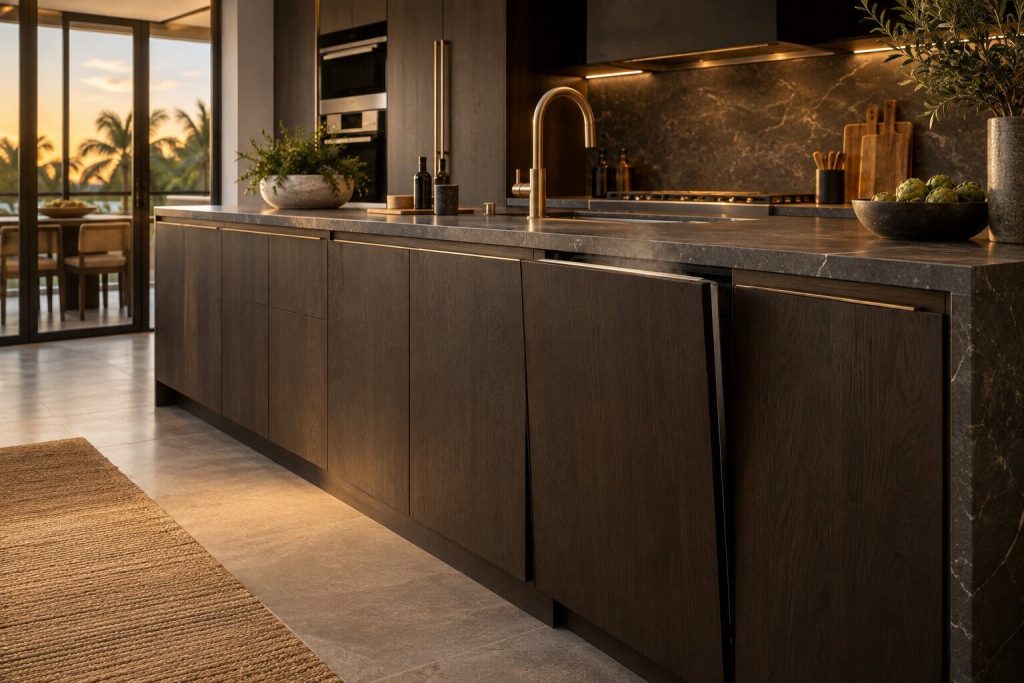
  • A panel-ready built-in refrigerator column faced with a dark oak cabinet front so it reads as tall joinery, standing in a fitted run, door closed, seen square on from a few feet back; the thin shadow gap and a recessed handle the only sign it is an appliance.
    Panel-ready French door · 24, 30 and 36-inch columns

    Refrigerators

    Two shapes, and the difference decides the visit. The French doors run 36, 42 and 48 inches wide and are built to take cabinet panels, so the box disappears into the joinery; the columns are 24, 30 and 36 inches of single-purpose refrigerator, meant to stand beside a freezer column of the same height and read as one run. Almost nothing here is freestanding in the ordinary sense. That changes the work before a part is named: the surround is tight, the panel and its handle come off first, and the air path the installer left is part of the diagnosis rather than a detail.

    • French doors at 36, 42 and 48 inches; columns at 24, 30 and 36
    • Panel-ready by default — the door furniture comes off before anything is opened
    • PreciseCooling, the FreshZone drawer and iQ Remote View are the named parts people call about
    Refrigerator repair
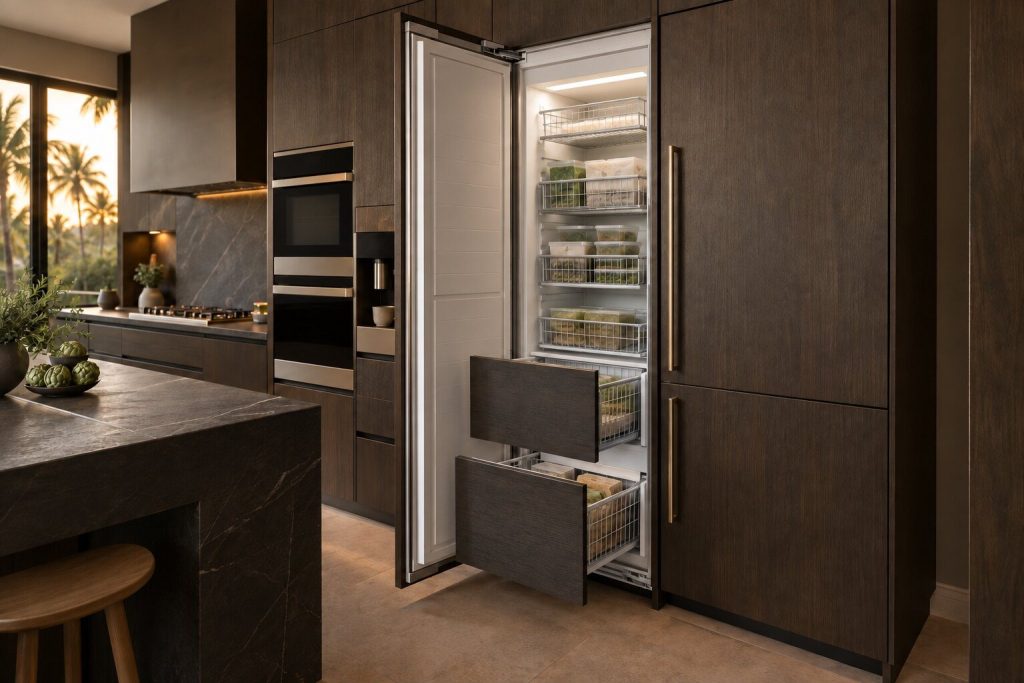
  • A tall panel-ready freezer column standing beside its refrigerator twin in a run of dark cabinetry, one door open to show wire baskets and two drawers drawn out, no frost anywhere.
    Column freezers · 18, 24, 30 and 36 inches

    Freezers

    There is no chest freezer here, and no upright one standing in a garage. Every freezer this make builds is a column — 18, 24, 30 and 36 inches wide, panel-ready, designed to be installed beside a refrigerator column of matching height so the two read as cabinetry. The narrow one holds about nine and a half cubic feet and carries two ice makers of its own. That shape is the reason most calls about it are really calls about installation: a column has a defined air path through its base or top, and a blocked one imitates a failing sealed system exactly.

    • Column-only: 18, 24, 30 and 36 inches, panel-ready, no freestanding cabinet in the line
    • The 18-inch column carries dual ice makers and two freezer drawers in 9.4 cubic feet
    • Power Freeze is a mode, not a problem — it will run the cabinet hard and sound wrong
    Freezer repair
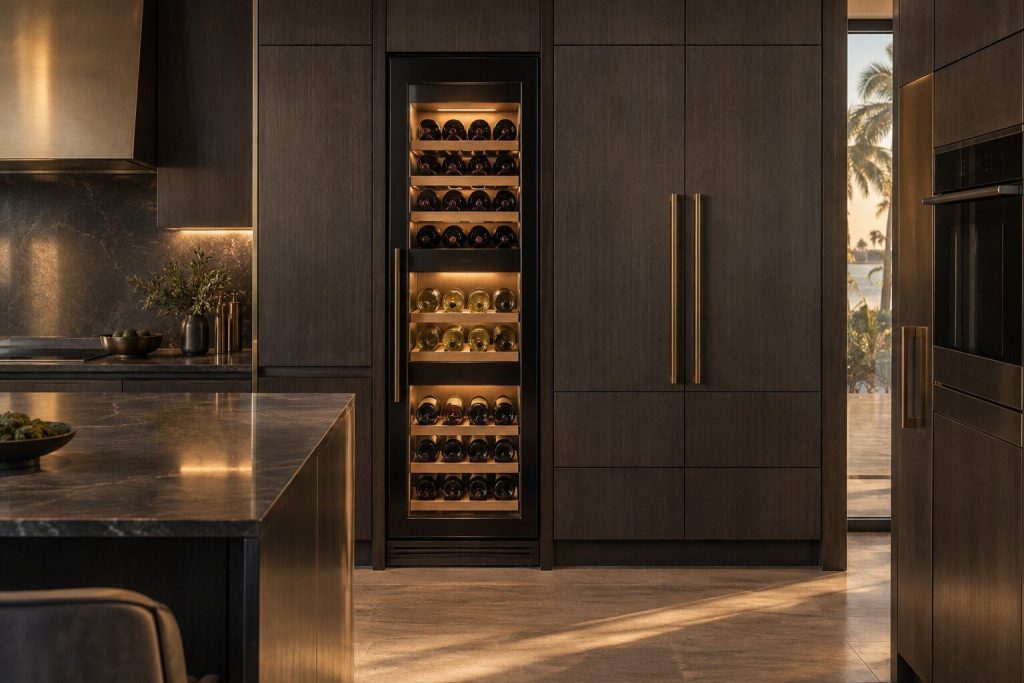
  • A full-height wine column with an argon-filled glass door, three lit zones of bottles on oak glide-out racks, seen square on in a dark fitted run.
    24-inch wine column · 100 bottles, three zones

    Wine columns

    One cabinet, taken seriously. The 24-inch wine column holds about a hundred bottles across three independently held zones behind argon-filled triple glazing, on oak racks that glide out and doors that push to open. It is specified to hold within a third of a degree, and that specification is the reason people call: a cabinet built to that tolerance is expected to keep it, and a drift of two degrees in one zone is a problem here where it would be ordinary elsewhere. There is a smaller undercounter cellar too — 41 bottles, two zones — and it is a different machine with different expectations.

    • 24-inch column: about 100 bottles, three zones, argon-filled triple glass, oak Glideracks
    • PreciseCooling is specified to about a third of a degree — drift is a symptom, not a mood
    • The undercounter cellar is a separate machine: 41 bottles, dual zone
    Wine cooler repair
  • A panel-ready dishwasher in a dark cabinet run with its door released a few inches at the end of a cycle, steam just visible at the gap, the cabinet front matching the doors either side.
    24-inch panel-ready · StormWash+ and AutoRelease

    Dishwashers

    Twenty-four inches, panel-ready, and two generations of it in South Florida kitchens. The current machine carries StormWash+, a water softener built into the appliance itself and an AutoRelease door that pops open at the end of a cycle to dry; the generation before it is the WaterWall platform with a third rack, quiet enough to be rated at 44 decibels. Behind both sits the problem language that changed in 2016: the older EDW and IDW machines report F-1 through F-9, the current ones report letter codes ending in C. Knowing which of those two a kitchen has is most of a diagnosis.

    • Current platform: StormWash+, built-in water softener, AutoRelease drying door
    • Previous Samsung-era platform: WaterWall, third rack, 44 dBA
    • Legacy EDW and IDW machines speak F-1–F-9 — a different language entirely
    Dishwasher repair
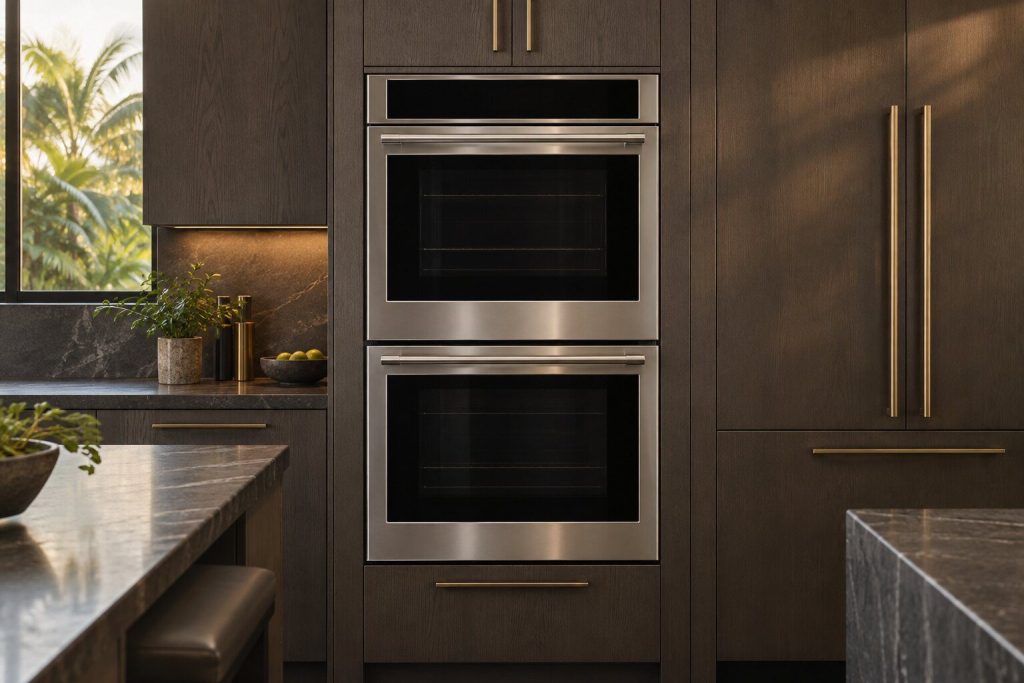
  • A 30-inch double wall oven set into a tall dark cabinet, both doors closed, its stainless frame flush with the joinery, seen square on from a few feet back.
    30-inch single and double · steam and non-steam

    Wall ovens

    Thirty inches, single or double, and the meaningful split is whether the cavity makes steam. The current ovens run a four-part convection arrangement, connect to the house network, and on the steam models add a water system that has to be filled, drained and descaled like any other. The style names — Contemporary, Transitional — change the hardware and the finish rather than the mechanism. Older kitchens hold the classic ERC ovens, and those report F0 through F8 from a board Dacor designed itself: a different oven, a different table, and a repair that begins with a different question.

    • 30-inch single and double, with and without steam
    • Four-part convection and a network connection on the current generation
    • Classic ERC ovens report F0–F8 — and F1, F2 and F3 mean something else on a range
    Wall oven repair
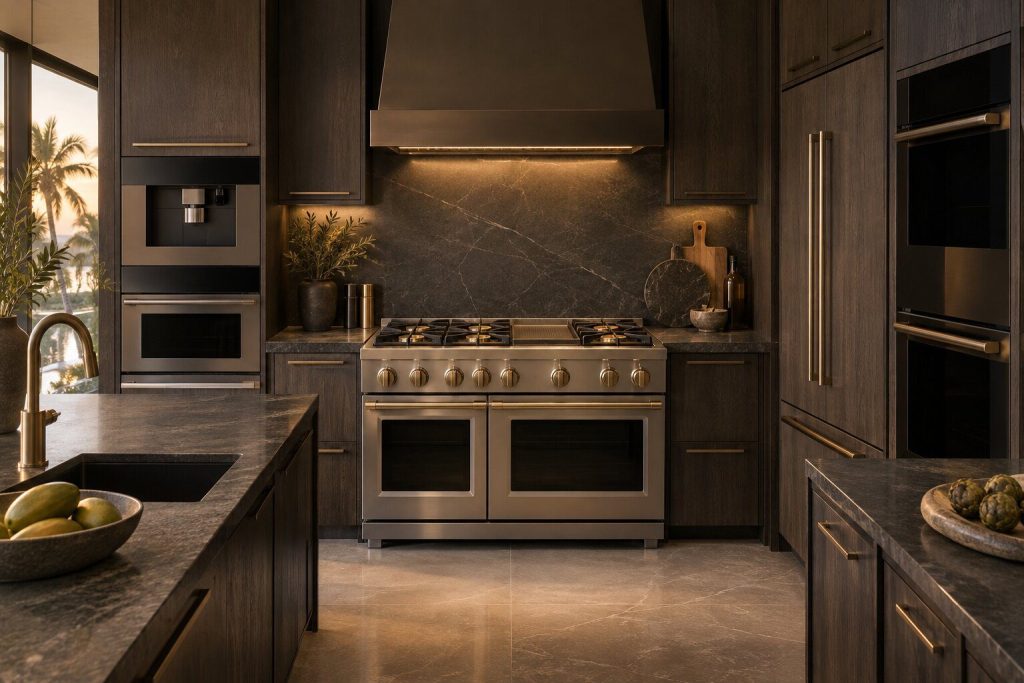
  • A 48-inch dual-fuel range in a dark fitted kitchen, six sealed brass burners and an integrated griddle across the top, heavy knobs along the front, seen square on.
    Dual-fuel at 30, 36 and 48 inches

    Ranges

    Thirty, thirty-six and forty-eight inches, and dual fuel almost throughout: gas on top, electric in the oven below. The forty-eight adds an integrated griddle and, on the steam models, a water system in the cavity. The professional range in this line carries six burners, a flame system designed to relight itself, and a seven-inch screen on the front. Beside all of that, South Florida kitchens still hold the ER-series ranges from before 2016 — a platform with its own diagnostic table running from F1 to F95, and one that a technician who only knows the current machines will read wrongly.

    • Dual-fuel at 30, 36 and 48 inches; the 48 carries an integrated griddle
    • The pro range: six burners, self-relighting flame, a seven-inch panel
    • Legacy ER30D, ER36D and ER48D report F1–F95 — the widest table this make has
    Range repair
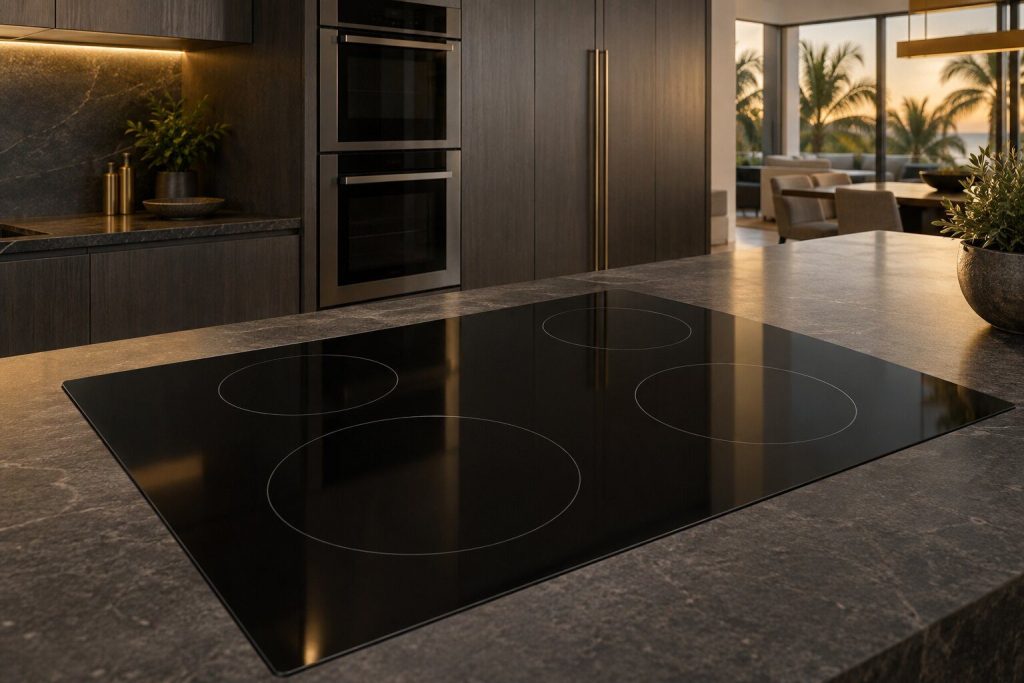
  • A frameless black glass induction cooktop set flush into honed dark stone, four zones printed on the surface, nothing on it, seen from slightly above.
    Induction and gas at 30 and 36 inches · rangetops at 36 and 48

    Cooktops and rangetops

    Two families under one heading. The cooktops are induction or gas at 30 and 36 inches — the induction ones frameless black glass with a display in the surface, the gas ones sealed burners on stainless. The rangetops are the professional half: 36 and 48 inches, six sealed brass burners built to simmer as well as sear, illuminated knobs, and a griddle and wok ring that sit in place of the grates. They are different machines to work on. A glass induction surface is an electronics repair; a rangetop is burners, gas and heavy brass, and the two rarely fail for the same reason.

    • Induction at 30 and 36 inches, frameless black glass with an in-surface display
    • Gas cooktops at 30 and 36; rangetops at 36 and 48 with six brass burners
    • The rangetop's griddle and wok ring replace grates — they are accessories, not fixtures
    Cooktop repair
  • A stainless pro-canopy wall hood above an empty cooking surface in a dark kitchen, its angled baffle filters visible from below, the canopy body deep and square.
    Pro-canopy at 36 and 48 · chimney and liner inserts

    Range hoods

    Three shapes, and which one is over the range decides everything about the repair. The pro canopies are 36 and 48 inches wide and about eighteen deep in the body, glass touch controls and LED light. The chimney hood is a 30-inch wall unit that extends up to the ceiling. The liners are inserts — five and a half inches tall — built to be hidden inside a joiner's custom hood, which means the appliance we are called to see is behind millwork nobody wants disturbed. Most hood calls are about the light, the fan speed control or the noise, and all three are reachable without touching the surround.

    • Pro-canopy wall hoods at 36 and 48 inches; a 30-inch chimney hood
    • Liner inserts at 30, 36 and 48 — about five and a half inches tall, built into custom millwork
    • Light, speed control and noise are the three calls; none needs the joinery opened
    Range hood repair

South Florida

The climate gets at this equipment through somebody's joinery.

  • A panel-ready column breathes through a grille nobody has seen Refrigeration here is built to disappear, which means one route for warm air out and a kick panel or a trim piece in front of it. In coastal air that route closes up quietly over a few years, and the cabinet then runs without pause while nothing inside it has failed.
  • Induction drives are cooled from the cabinet below The glass cooking surfaces draw their cooling air from the space underneath. Where a renovation filled that space with insulation or a drawer stacked to the top, zones step back after five minutes at high power in August and behave perfectly in January.
  • A wine column's outer pane should not be cold The hundred-bottle column is argon-filled triple glazing holding three zones to about a third of a degree. In an open-plan kitchen at eighty percent humidity, a door that has lost its seal condenses continuously and the compressor spends the summer losing ground.
  • A hidden hood liner fills where nobody can look The liner inserts are about five and a half inches tall inside a hood a joiner built. Grease collects on a blower wheel that is out of sight, the balance goes, and a kitchen that stopped clearing a year ago is still on its original filters.
  • Salt air ends a legacy board that cannot be replaced Machines built before 2016 run Dacor's own control boards, and humidity and salt reach them through the same cabinetry that hides everything else. That is the one failure here where the part, not the labor, decides whether the appliance has a future.

When the machine does say something

Two eras that share not one code string

This make built its own control boards until 2016 and has run the Samsung platform since. The two generations do not share a single error code, and the same characters mean different things on different appliances of the same age. Every page here names the appliance and the era before it gives a meaning.

One string, and the two facts that give it meaning

Photograph the display before you reach for the breaker, then find the model number. On this make the second is worth as much as the first.

Four shapes this make reports in

  • A letter and a number on the pre-2016 ovens and ranges — F0 to F8 on the Classic ERC machines, and F1 through F95 on the ER-series ranges.
  • A C and two characters on the current ovens and ranges — C-20, C-21, C-F0, C-A2 and the rest of the Modernist table.
  • A letter pair ending in C on the current dishwashers — LC, 4C, 5C, HC, 3C, PC — and an F with a dash on the EDW and IDW machines before them.
  • Whole sentences on the built-in coffee system, which has no code table at all and writes what it wants on the display instead.

Five we are called about most, and what each is actually saying

C-21 The current ovens and ranges reporting an abnormally high internal temperature and stopping. The appliance protecting itself, usually a welded relay or a sensor reading far too low — and the one code that should never be cleared and re-run to see what happens.
LC A current dishwasher that has detected a leak and shut itself down. Behind a cabinet panel that intervention is the difference between a repair and a floor. Close the supply valve; do not clear it and start another cycle.
F-4 An EDW or IDW dishwasher from before 2016 reporting water still in the sump after draining. Very often nothing to do with the appliance: a disposal plug left in after a kitchen fit, or a drain hose that lost its high loop.
F20 An ER-series range naming a loose or failed data cable between the relay board and the control panel. The best code in that table, because it names a cable rather than a board — and it is checked before anybody quotes for a panel.
AP Not a failure at all: a current dishwasher waiting to be paired with a phone. It is here because from across a kitchen a pairing prompt and a error code look identical, and one of them needs a visit.

Each has its own page under the appliance and the era it belongs to, because the same characters on a 2012 range and a 2019 one are two different repairs. Type what you can see into the index and it will find it.

Photograph the panel first and reset second. A code that clears and stays clear was a condition rather than a failure; one that returns has a part behind it, and repeated resetting only hides how often it is happening.

All 68 conditions

Nothing is listed for the refrigeration, the freezer columns, the wine column, the hoods or the microwaves, because this make publishes no codes for them in either era — four named alarms in an app, or a single generic word, and no table anywhere. On those the symptom pages carry the diagnosis instead. Twenty-four strings that circulate as Dacor codes are refused here outright, several of them contradicted by the maker's own manuals.

How a visit goes

Measured, priced, then agreed — in that order

  1. 01

    You give us the machine and what it is doing

    The model and serial from the rating plate, and a photograph of the panel if there is anything on it. On this badge the number does something extra: it says which side of the 2016 acquisition the appliance was built, and that decides the code table and the part number before anything else is discussed.

  2. 02

    The free checks come before the van does

    An induction zone that cuts out after five minutes at high power is usually defending itself against a cabinet packed tight underneath. A dishwasher door that opens itself at the end of a cycle is the drying system. A hood that starts on its own during a hard sear is doing what it was designed to do. None of the three is a repair.

  3. 03

    The figure comes before anything is opened

    Parts, availability and labor, in writing — and on this badge the access quoted as its own line rather than folded into a part. On a legacy machine the availability answer comes first of all, because nobody should pay for a visit that ends in a shrug. Nothing is ordered until you have said yes, and the diagnostic comes off the bill when you do.

  4. 04

    And often it is one visit rather than two

    On the current generation the parts channel is a high-volume one and the ordinary components are stocked rather than ordered. What sets the figure here is the other half — almost everything this make sells has to be brought forward out of the joinery before it can be reached, and putting that joinery back exactly as it was is part of the job.

What it costs

Every figure is a floor, and every floor has a page

45 jobs with a published starting figure and a page behind each saying what moves it. Nothing here is a quote and no final price appears anywhere on this site: the number is measured at your machine and agreed in writing first.

Diagnostic visit

from $95

One visit, one written answer, and the fee comes off the work when you go ahead. On this make it buys two answers rather than one: what has failed, and which generation of the appliance failed it. The second is what stops a correct diagnosis buying the wrong part.

Dishwasher drain and pump repair

from $165

Not a repair at all on most visits. The filter and the sump clear by hand, and very often the cause is beyond the appliance — a disposal plug left in after a kitchen fit, or a drain hose that lost its high loop. What makes it a repair is water still standing with the path proven clear.

Condenser cleaning

from $129

The cheapest thing that can be done to refrigeration here and the one most often skipped. Behind a trim kit the coil breathes through a route a joiner decided years ago, and in coastal air it closes up quietly — after which the cabinet runs without pause while nothing inside it has failed.

Refrigerator not cooling

from $185

Which cabinet you have decides the diagnosis. On a French door one sealed system serves both compartments, so a single warm side is airflow rather than refrigerant. On a column pair there are two independent systems, and the cold cabinet standing beside the warm one is evidence rather than a symptom.

Induction cooktop and range repair

from $205

Half of what arrives as a failure is thermal protection or a pan that will not couple, and both are free to rule out. A zone that runs five minutes at high power and stops is usually shedding heat it cannot lose, and the cause is under the worktop rather than in the appliance.

Legacy control diagnosis

from $125

The service that exists because this badge changed hands in 2016. Reading an F-code table that is not the current one, on a board that is no longer made, and answering the parts question honestly before any labor is booked. It is why owners told their machine cannot be fixed so often find that it can.

Every figure here is a starting point and a researched market band for South Florida, never a quote and never an invoice. The exact cost is confirmed after an on-site diagnostic and agreed in writing before anything is opened.

Every figure and what moves it

Where we work

Miami-Dade, Broward and Palm Beach, end to end

59 cities and neighborhoods, each with a page saying what we actually see there. Tell us where you are when you book — and if it is a building with a service elevator and its own hours, tell us that too.

Coverage is Miami-Dade, Broward and Palm Beach counties — the pages below are the places people search for by name, not the edge of where we drive.

The appliance, the model number, and what the panel shows.

A photograph of the display is ideal, taken before anybody cuts the power — there is no way to ask the machine for a code again. Add roughly when the kitchen was fitted, because on this make the era decides the code table. Where there is nothing on the panel at all, which is the case on five of these ten appliances, tell us what it does and when.

This article is based on:

  • Official manufacturer documentation
  • Internal repair procedures
  • Technician repair history
  • Company quality standards

Before you call

The questions we are asked most

Is it worth repairing, or should I just replace it?

On this badge the arithmetic is not the one people expect. These appliances were specified into a kitchen, and replacing a panel-ready column or a fitted wall oven means matching an opening, a trim kit and a cabinet front — so a repair that would be marginal on a freestanding machine is frequently the right call here. Where it is not, or where a legacy part is genuinely no longer made, we say so before anything is ordered.

The refrigerator is warm but the freezer is fine. Is that two problems?

It depends which cabinet you have, and that is the first thing we ask. On a French door one sealed system serves both compartments and air is moved between them, so a single warm side points at the air path — a fan, a damper, a duct closed up with ice — rather than at refrigerant. On a pair of columns it is the opposite: two independent machines, and the healthy one is the most useful measurement in the kitchen.

I have a code but it is not in your archive.

Then one of two things is true. Either it belongs to an appliance this make publishes nothing for — the refrigeration, the freezer columns, the wine column, the hoods and the microwaves, where the symptom pages are the honest place to start — or it is one of the strings that circulate widely with no manufacturer document behind them. Several of those are contradicted by the maker's own manuals, and we refuse to publish them.

The panel lights up and every button is ignored.

Dry the panel and give it an hour before anything else. On the current cooktops and ovens a wiped surface reads exactly like a finger held on a key, and the machine reports it as a stuck control — C-d0 on an oven, d0 on an induction top. Both clear themselves once the glass is dry, and both cost a call-out fee every week somewhere.

Does the series number change the repair?

Less than the era does. Contemporary, Transitional and Professional are finish and hardware styles within the current generation rather than different machines, and Modernist is the name for that generation as a whole. What genuinely changes the repair is whether the appliance was built before or after September 2016 — and Heritage, which people reasonably read as an era, is a collection name rather than one.

Are you connected to Dacor?

No. We are an independent repair company working in Miami, not affiliated with, authorized by or endorsed by any manufacturer, and we warrant our own workmanship rather than anybody else's. What we do have is 68 documented codes across this make's two eras, each traced to one of seven manufacturer documents, 25 symptom pages for the five appliances it publishes nothing for, and 45 jobs with a published starting figure.

Call (305) 363-6067